

What’s happening at Ferryhill
Department of Art and Design 3
Good morning, everyone. Did you have a chance to research the Niagara Falls? Did you come across the photo showing people walking on the Falls? This was due to partial freezing of the waterfalls due to ice jams. This happened a few times in history, the last time in 2019, the winter when I visited my daughter in Canada. We went to Niagara Falls to see the ice floating down the river. The warmest temperature during our holiday was -21C. This is colder than your ice box.
Did you read about people going down the Falls in a barrel? Or did you see the photo of the man walking across on a tightrope? That’s so scary!
The reason for us not seeing as much water rushing down the waterfall as Frederic Edwin Church did when he painted his picture ‘Niagara Falls’ in the 1860s is that engineers have built a hydro power station since. Some of the water is channelled away to create electricity.
Do you remember where you can see the painting of ‘Niagara Falls’? Correct! It is located at the Scottish National Gallery. We can’t go there today. The galleries are in lockdown, too, but you can go online to nationalgalleries.org and find out more about the picture.
Yesterday’s task was to find a picture of the Scottish National Gallery and create a line drawing of it with pen. Did you manage to do it without using a pencil first? I must admit that it was tricky. I used a pencil for the even spacing of the columns. Then I went over it with pen. The problem is that there will be traces of erased pencil.

Do not worry if your drawing is just a set of scribbles.
P3-4: How many different shapes can you spot?
P5-7: What does this building look like? Have you seen similar buildings before? In which country would you expect to find buildings like this?
The Scottish National Gallery was designed by William Henry Playfair, a famous architect. It was completed in 1856. How many years ago is that?
It was built in a neoclassical style. This means that it looks very grand. It has simple geometric forms. There are lots of columns. The columns used for the Scottish National Gallery are ionic columns. Their capital, that is the term for the top of the column, looks like a scroll or a snail’s house.
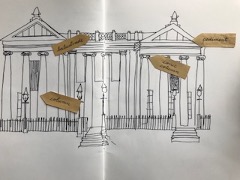
Our STEM experts may want to find out more about neoclassical and classical architecture. Why are mathematics and engineering important for architecture?
If you have any spare time, look up the technical terms in the above picture.
Today’s task is very simple.
You will need paper from the recycling bin, scissors, glue.
You are going to make a collage of a dog being walked on the pavement in front of the Scottish National Gallery. P4B made some fabulous dogs and dog-walkers for their display of the Royal Mile. It was outside the office and all of you will have walked past it.
Your dog can look as simple as this – or really fancy. Don’t forget the collar!


Enjoy! Dr Stahl
Department of Art and Design 2
Good afternoon boys and girls of Ferryhill. Are your rainbows up in your windows? Ours are. I am saying ‘ours’, but it was my 16-year-old daughter who painted two rainbows. One for the windows to the front and one for her own bedroom which is facing the garden and the tenements across the lane.
This is the picture the little boy from downstairs drew with chalks on his house wall. He had his mother’s permission, in fact, I think his mother drew the sun, the cloud, the rainbow and the red flower and he did the rain and the white flowers.
Drawing on walls is a bit risky unless you own the wall. Do you own any walls? Stick to pavements for chalk drawings until you have bought your first house.

I tried to make a rainbow with unusual materials, some limp fruit and vegetables found at the back of my fridge. Can you name any of the fruit/ veg I used? Have you tried any of them before? What do you think of my artwork? Is it Art?

You are right, some colours are missing. Which ones?
Yesterday we finished with looking at the ‘Niagara Falls, from the American Side’ picture by Frederic Edwin Church. The rainbow was in the bottom right corner. Well spotted. Church painted the picture in 1867 from sketches he made on site and from some photographs. Photography had just been invented. It was also the beginning of tourism. But let’s not go there today, on Lockdown Day 2, when our longest journey must not be further than to our local supermarket.
Today’s tasks
- Between which two countries are the Niagara Falls located?
- Name the continent.
- Find at least three interesting facts about Niagara Falls.
For our STEM lovers or any pupils in the upper school years:
- Why do modern day visitors to the Niagara Falls see a lot less water than Frederic Church did when he visited the Falls in the 1860s? (It doesn’t have anything to do with rainfall.)
This painting is located in the National Gallery of Scotland on the Mound right in the centre of Edinburgh.
- Locate the Gallery on googlemaps.
- Find a picture of the building of the National Gallery of Scotland (on the Mound). Sometimes it is called ‘Scottish National Gallery’.
- Take an A4 piece of paper. Landscape format.
- Make a line drawing of the gallery. Leave 5 – 8cm space at the bottom of the picture for a pavement. Do not fill the whole page because we will need space for a pavement in front of the gallery. Use a felt tip pen. Ignore any mistakes you make.
We will need this picture for tomorrow’s task.
Just in case you forgot what a line drawing was. This is one I made of the Old Town. Please remember to leave space for the pavement.
Department of Art and Design 1

Good morning boys and girls from Ferryhill Primary School. I hope you are all well and ready for your first online Art lesson. It’s my first online Art lesson ever, too, so I am learning with you as we go along.
We’ll start off with something simple. Today we need to make a Rainbow picture for the window of your flat that is facing the road. All over the world children are currently painting, drawing, making collages of rainbows which they display in their windows to show solidarity. Solidarity means that you are thinking of others and that no one is alone. The two little girls in the ground floor flat two doors along from mine have a rainbow picture in their window and it cheers me up every time I look out of my living room window.
Before you rush to draw a rainbow using up your precious felt tip pens, stop and think.
What are the colours of the rainbow?
Can you sing the colours of the rainbow? In Germany we don’t have the song that all of you seem to learn at nursery. You are definitely a step ahead of Germany!
Can you make a rainbow from things you find in your recycling bin? Can you make a collage? We don’t want to wear out your felt-tip pens in the first week. What other materials could you use instead? Take a photo of your work and try and upload it.
Will you just make a rainbow or can you add something else? Is there a story?
For those of you in the upper classes I’d like you to find out online why there are different colours in a rainbow.
Check out ‘How a Prism Works to Make Rainbow Colors’ on youtube. I think some of you STEM whizzkids might like it.
If you have any time left check out the website of the National Galleries of Scotland. One of my favourite pictures is by Frederic Edwin Church, Niagara Falls from the American Side, 1867.
Go to www.nationalgalleries.org. Type in Frederic Edwin Church into the finder and you’ll be directed to this picture.
Can you spot the rainbow?
Have fun and let me know how you get on.
Dr Stahl
Sumdog Weekly Challenge

There are 2 new weekly challenges on Sumdog, one for pupils from Primary 1 to Primary 3 and another for pupils from Primary 4 to Primary 7. Good luck with this weeks challenge.
 Ferryhill Primary School